
Physical Therapy for the Mouth, Tongue, and Airway
If you or your child struggles with mouth breathing, tongue thrust, low tongue posture, snoring, poor sleep, crowded teeth, orthodontic relapse, or improper swallowing patterns, the root cause may involve how the muscles of the tongue, lips, cheeks, and face are functioning.
At Dr. Hana Khan, DDS — Airway Dentist in Torrance, CA, we provide orofacial myofunctional therapy to help children and adults retrain oral and facial muscles for healthier breathing, swallowing, tongue posture, and long-term airway support.
Located inside Smile HQ at 3500 Lomita Blvd, Unit 201, Torrance, CA 90505, Dr. Khan serves patients from Torrance, the South Bay, and surrounding Los Angeles County communities with a root-cause, education-focused approach to airway-centered care.
What Is Myofunctional Therapy?
Myofunctional therapy is often described as physical therapy for the mouth, tongue, and airway.
It uses guided exercises and habit retraining to improve the way the tongue, lips, cheeks, jaw, and facial muscles work together. These muscles influence much more than your smile.
Oral Muscles Influence Airway, Growth, Sleep, and Stability
- Nasal breathing
- Tongue posture
- Swallowing patterns
- Lip seal
- Jaw development
- Facial growth in children
- Dental stability after orthodontics
- Sleep and airway function
- Oral habits such as thumb sucking or open-mouth posture
When these muscles are not functioning properly, the body may adapt in ways that affect breathing, sleep, bite development, and long-term oral health.
Looking for Myofunctional Therapy Near Me?
If you searched for “myofunctional therapy near me” and are located in Torrance, Redondo Beach, Palos Verdes, Hermosa Beach, Manhattan Beach, Lomita, Gardena, Carson, or the South Bay, Dr. Hana Khan offers airway-focused myofunctional therapy evaluations and personalized treatment planning.
Dr. Khan combines her background as a UCLA-trained dentist with advanced training in airway-centered dentistry and orofacial myology to help patients understand not only what is happening, but why it may be happening.
Signs You or Your Child May Benefit from Orofacial Myofunctional Therapy
Myofunctional therapy may be recommended when oral and facial muscle patterns are contributing to breathing, dental, orthodontic, or airway concerns.
Common Signs in Children
- Mouth breathing during the day or night
- Sleeping with the mouth open
- Snoring or restless sleep
- Crowded teeth
- Narrow arches or jaw development concerns
- Tongue thrust
- Lisping or speech-related muscle patterns
- Difficulty keeping lips closed at rest
- Thumb sucking, pacifier habits, or prolonged oral habits
- Messy eating or improper chewing patterns
- Forward head posture
- Orthodontic relapse risk
- Enlarged tonsils, adenoids, or airway concerns
Common Signs in Adults
- Chronic mouth breathing
- Low tongue posture
- Tongue thrust swallow
- Snoring or sleep-disordered breathing risk factors
- Waking up tired or with dry mouth
- Clenching or jaw tension patterns
- Orthodontic relapse after braces or aligners
- Difficulty nasal breathing
- Poor lip seal
- TMJ-related muscle tension
- Long-term dental instability
Myofunctional therapy does not replace medical diagnosis or treatment for sleep apnea or airway obstruction, but it can be an important part of a collaborative care plan.
Why Tongue Posture and Breathing Matter
The tongue is one of the most important muscles involved in oral and airway health.
At rest, the tongue should ideally sit gently against the roof of the mouth, with the lips closed and breathing through the nose. When the tongue rests low in the mouth or the lips remain open, the body may shift into mouth breathing.
This is why Dr. Khan takes an airway-centered approach. The goal is not just to straighten teeth or address symptoms. The goal is to understand how breathing, oral posture, muscle function, and jaw development are connected.
Over Time, Mouth Breathing and Poor Tongue Posture May Contribute To
- Narrow upper jaw development
- Crowded teeth
- Poor facial growth patterns in children
- Open bite or orthodontic instability
- Dry mouth and increased oral health risks
- Improper swallowing mechanics
- Snoring and sleep-related breathing concerns
- Poor oxygenation during sleep
- Muscle compensation in the jaw, neck, and face
Myofunctional Therapy Exercises: What Do They Involve?
Many patients search for “myofunctional therapy exercises” because they want to understand what therapy looks like.
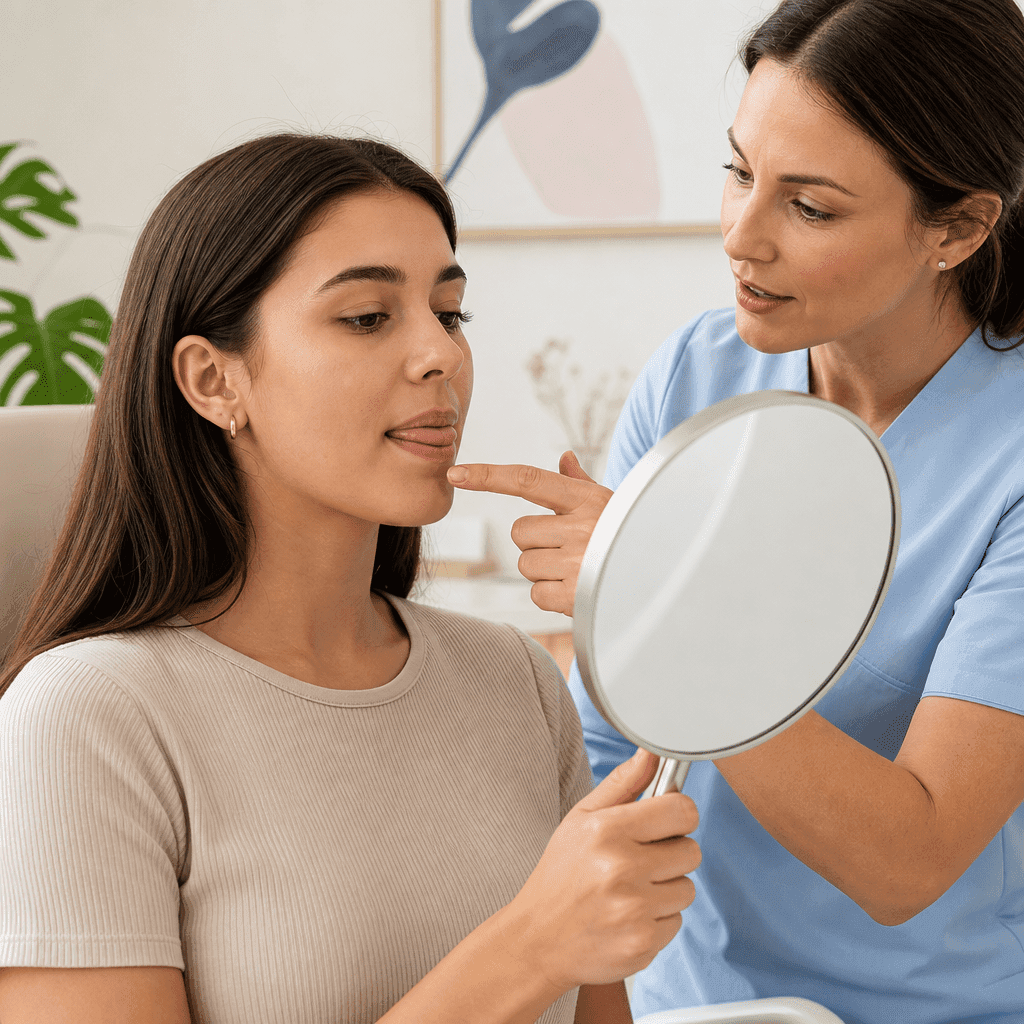
Myofunctional therapy exercises are customized to each patient, but they may focus on improving tongue strength, tongue elevation, proper tongue resting posture, lip seal, nasal breathing habits, chewing and swallowing patterns, coordination of oral and facial muscles, awareness of mouth posture during the day, elimination of tongue thrust patterns, and support for long-term orthodontic stability.
These exercises are typically simple, but consistency matters. Much like physical therapy, progress depends on proper technique, repetition, and guidance.
At Dr. Hana Khan’s office, exercises are selected based on a detailed evaluation rather than a one-size-fits-all program.
Conditions and Concerns Myofunctional Therapy May Help Support
Orofacial myofunctional therapy may be part of a care plan for patients with mouth breathing, tongue thrust, low tongue posture, improper swallowing patterns, snoring risk factors, sleep-disordered breathing concerns, orthodontic relapse, crowded teeth related to oral posture and jaw development, narrow palate or arch development concerns, oral habits in children, poor lip seal, jaw muscle compensation, and airway-centered orthodontic concerns.
For children, therapy may help support healthier growth patterns by improving nasal breathing, tongue posture, and oral muscle function during development.
For adults, therapy may improve muscle patterns that affect sleep, breathing, dental stability, and long-term oral function.
Myofunctional Therapy for Children
Children are still growing, which makes early evaluation especially valuable.
When a child breathes through the mouth, rests the tongue low, or swallows incorrectly, these patterns may influence how the jaws, palate, teeth, and airway develop.
- Better nasal breathing habits
- Proper tongue posture
- Improved lip seal
- Healthier swallowing patterns
- Reduction of tongue thrust patterns
- Support during orthodontic or growth-guidance treatment
- Better awareness of oral habits
- More stable long-term dental development
Dr. Khan’s approach is gentle, educational, and parent-friendly. She helps families understand how oral function connects to sleep, breathing, behavior, growth, and long-term health.
Myofunctional Therapy for Adults
Adults can also benefit from orofacial myofunctional therapy.
Even if the jaws and facial structures are fully developed, the muscles of the mouth and face can still be retrained. Adults often seek myofunctional therapy because they are dealing with ongoing symptoms or patterns that were never addressed earlier in life.
- Improved tongue posture
- Better nasal breathing habits
- More stable orthodontic results
- Reduced tongue thrust patterns
- Improved swallowing mechanics
- Better lip seal
- Support for airway-focused dental treatment
- Improved awareness of clenching, jaw tension, or compensation patterns
- Collaborative support for sleep-disordered breathing care
For adults with snoring or sleep apnea concerns, Dr. Khan may recommend collaboration with physicians, ENTs, sleep specialists, orthodontists, or other providers depending on the findings.
Dr. Hana Khan’s Root-Cause Approach
Dr. Hana Khan does not believe in treating symptoms in isolation. Her airway-centered approach focuses on understanding the deeper reasons behind breathing, sleep, orthodontic, and oral function concerns.
During Your Evaluation, Dr. Khan May Assess
- Tongue posture
- Lip seal
- Swallowing pattern
- Breathing route
- Palate and arch development
- Oral habits
- Facial muscle function
- Signs of airway restriction
- Orthodontic history or relapse
- Sleep and breathing symptoms
- Jaw and bite relationships
Advanced Assessments When Needed
- CBCT imaging
- High-resolution pulse oximetry
- Rhinomanometry
- Myofunctional exams
- Airway-focused dental evaluation
- Personalized treatment planning
The goal is to help each patient understand the “why” behind the recommendation and create a plan that supports better function naturally.
What to Expect at Your Myofunctional Therapy Evaluation
Your visit begins with a comprehensive conversation about your symptoms, habits, concerns, and goals.
- Health and airway history: Dr. Khan will ask about breathing, sleep, snoring, dental history, orthodontics, oral habits, and related symptoms.
- Oral and facial muscle assessment: She will evaluate tongue movement, tongue posture, lip seal, cheek function, jaw patterns, and swallowing mechanics.
- Breathing and airway screening: Depending on your symptoms, additional airway-focused assessments may be recommended.
- Personalized therapy recommendations: If myofunctional therapy is appropriate, Dr. Khan will explain the recommended exercises, goals, timeline, and how therapy fits into your broader airway or dental plan.
- Collaborative care when needed: If other providers should be involved, such as an ENT, orthodontist, sleep physician, or bodyworker, Dr. Khan will help guide that conversation.
Why Choose Dr. Hana Khan for Orofacial Myofunctional Therapy?
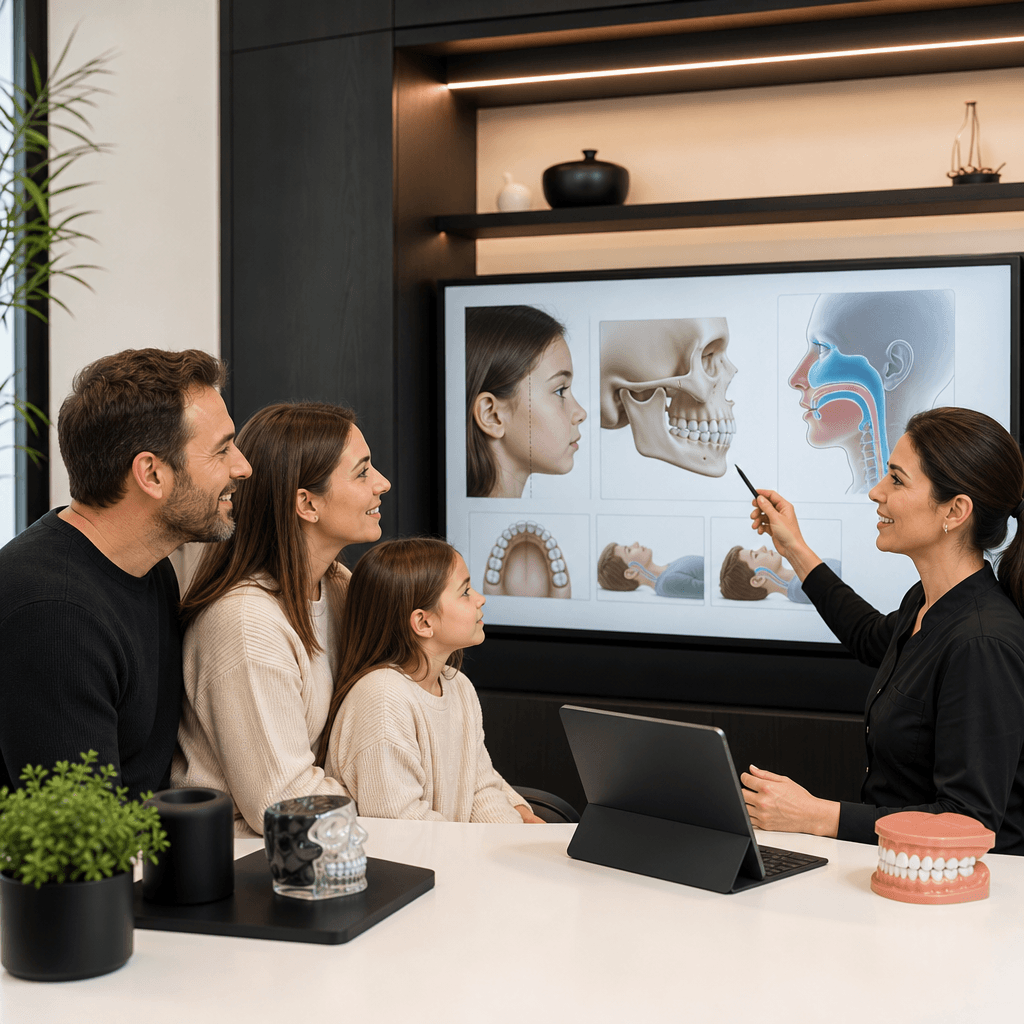
Patients choose Dr. Hana Khan because her care is both functional and educational. She takes the time to explain how the mouth, airway, tongue, jaw, and sleep are connected.
- UCLA School of Dentistry graduate
- Airway-focused dentist
- Training in airway-centered dentistry and orofacial myology
- Experience treating children and adults
- Root-cause evaluation instead of symptom-only care
- Personalized myofunctional therapy plans
- Collaborative approach with other healthcare providers
- Advanced airway-focused assessment tools
- Convenient Torrance location inside Smile HQ
- Serving the South Bay and Los Angeles County communities
Dr. Khan’s goal is to help patients breathe better, sleep better, and support long-term airway and oral health.
Myofunctional Therapy and Orthodontic Stability
One of the most common reasons patients are referred for myofunctional therapy is orthodontic relapse.
Braces or aligners can move teeth, but if the tongue, lips, cheeks, and swallowing patterns continue to apply improper forces, teeth may shift again over time.
- Teeth shifting after braces
- Open bite relapse
- Tongue thrust against front teeth
- Poor retainer stability
- Narrow arch development
- Crowding related to poor oral posture
By improving oral muscle function, myofunctional therapy can support more stable orthodontic outcomes.
Myofunctional Therapy and Sleep-Disordered Breathing
The muscles of the tongue and airway play an important role in nighttime breathing.
Low tongue posture, mouth breathing, poor oral muscle tone, and improper jaw development may contribute to airway resistance and sleep-disordered breathing risk factors.
- Nasal breathing
- Tongue posture
- Lip seal during sleep
- Airway muscle tone
- Snoring risk factors
- Long-term airway health
If sleep apnea is suspected, Dr. Khan may recommend proper medical testing or collaboration with a sleep physician. Myofunctional therapy can be supportive, but it is not a replacement for medical diagnosis or treatment when needed.
Serving Torrance, the South Bay, and Los Angeles County
Dr. Hana Khan provides myofunctional therapy and airway-centered dental care for patients from Torrance, Redondo Beach, Hermosa Beach, Manhattan Beach, Palos Verdes, Rolling Hills, Lomita, Carson, Gardena, San Pedro, Long Beach, El Segundo, and Greater Los Angeles County.
Convenient Torrance Office
Our office is conveniently located at:
Dr. Hana Khan, DDS — Airway Dentist
Inside Smile HQ
3500 Lomita Blvd, Unit 201
Torrance, CA 90505
Schedule a Myofunctional Therapy Consultation in Torrance
If you or your child has been struggling with mouth breathing, tongue thrust, snoring, poor sleep, orthodontic relapse, or concerns about jaw growth and airway health, myofunctional therapy may help address the underlying muscle patterns involved.
Dr. Hana Khan offers a thoughtful, personalized, and root-cause approach to orofacial myofunctional therapy in Torrance, CA.
Schedule a consultation today to learn how myofunctional therapy can support better breathing, better sleep, and healthier oral function.
Patient Testimonial
We are honored to share our patient testimonial, highlighting a real experience with Dr. Hana Khan’s thoughtful and airway-centered approach to care. This story reflects the importance of looking beyond symptoms and understanding how breathing, sleep, oral function, and overall wellness are connected.
At our practice, every patient is treated with compassion, education, and personalized attention. We are grateful for the trust our patients place in Dr. Khan and hope this testimonial helps other families feel more confident about taking the next step toward better health.
Frequently Asked Questions About Myofunctional Therapy
Orofacial myofunctional therapy is a series of guided exercises and habit retraining techniques that help improve the function of the tongue, lips, cheeks, and facial muscles. It supports proper breathing, swallowing, tongue posture, and oral rest posture.
Tongue exercises are part of myofunctional therapy, but therapy is more comprehensive. It may also include lip seal training, nasal breathing awareness, swallowing retraining, chewing coordination, oral posture habits, and exercises for facial muscle balance.
Myofunctional therapy can help retrain oral posture and encourage nasal breathing habits. However, if there is a structural blockage, such as enlarged tonsils, adenoids, or nasal obstruction, Dr. Khan may recommend collaboration with an ENT or medical provider.
Yes. Children can benefit from myofunctional therapy, especially when mouth breathing, low tongue posture, tongue thrust, oral habits, or jaw growth concerns are present. Therapy is adapted to the child’s age, development, and ability to participate.
Yes. Adults can retrain oral and facial muscle patterns. Myofunctional therapy may help adults improve tongue posture, swallowing patterns, lip seal, nasal breathing habits, and orthodontic stability.
Dr. Hana Khan provides myofunctional therapy in Torrance, CA, inside Smile HQ at 3500 Lomita Blvd, Unit 201. She serves patients throughout the South Bay and surrounding Los Angeles County areas.